A smarter, more saavy approach to protecting your bones, without panic, and without noise.
At some point in midlife, our bodies stops responding the way it used to, yet no one handed us a manual for what comes next. Most of our mothers, were in a “mum is the word” mode when it came to discussing perimenopause and menopause symptoms. It can feel like we’re flying in the dark.
There is a particular moment in midlife when the conversation around your body changes.
Not loudly.
Not dramatically.
But unmistakably.
You go from optimizing…
to preserving.
Bone density becomes a topic. Fracture risk enters the room.
Words like osteopenia and osteoporosis begin to circulate with quiet authority.
Beneath all of it is a subtle, yet anxiety-inducing question…
Is my body slowly becoming more fragile?
The answer is more nuanced than most headlines would suggest.
Because what’s happening in midlife is not simply loss.
It’s a recalibration.
And if you understand the biology, and work with it instead of against it, you can support your bones in a way that is not only effective, but intelligent.
What Actually Happens to Bone in Perimenopause and Menopause
Bone is not static.
It is alive, constantly remodeling through two opposing processes:
- Osteoclasts break down bone
- Osteoblasts build new bone
Under normal conditions, these processes exist in balance.
Estrogen plays a critical role in maintaining that balance by:
- Slowing bone breakdown
- Supporting bone formation
But during menopause, estrogen declines.
And when it does, the system shifts.
Bone resorption begins to outpace formation.
This transition often starts before your final period and accelerates rapidly in the years surrounding it, increasing the risk of osteopenia and osteoporosis.
So the question becomes…
How do you support a system that has lost one of its primary regulatory signals?
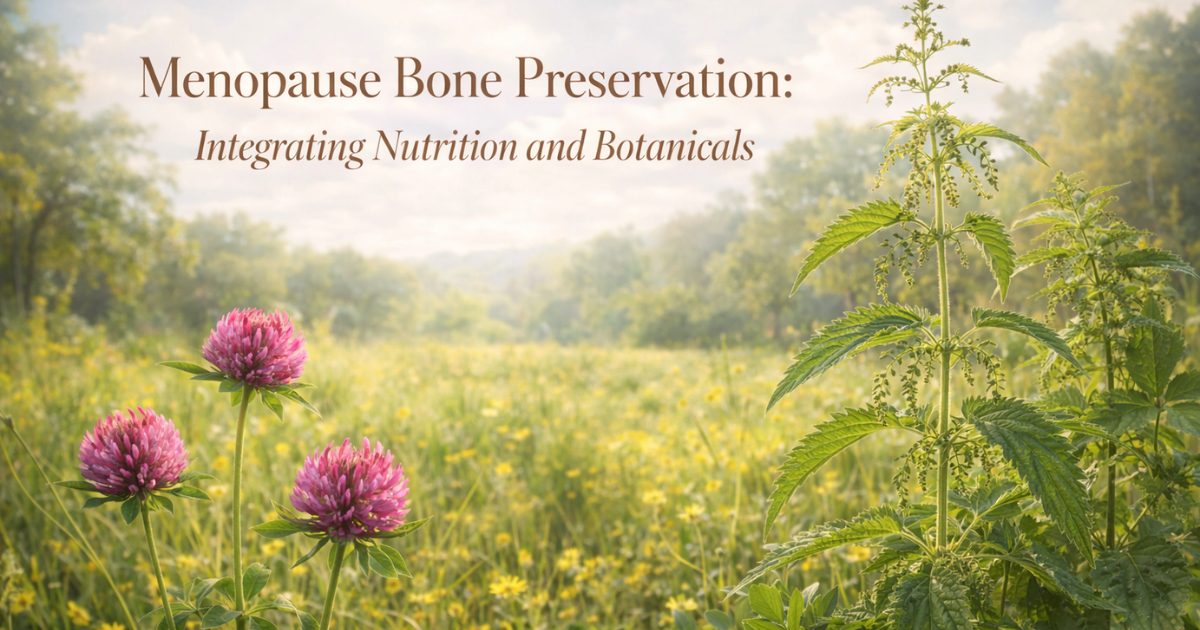
Red Clover: Reintroducing Hormonal Intelligence to the System
Red Clover is not just a plant.
It is a signal.
Rich in phytoestrogens, specifically isoflavones like formononetin and biochanin A, it acts as a selective estrogen receptor modulator (SERM). Say that, 3 times fast.
In simpler terms:
It doesn’t replace estrogen. It communicates with the same receptors.
What This Means for Bone
Red Clover supports bone health in two critical ways:
1. It encourages bone formation
Formononetin has been shown to stimulate osteoblast activity, helping your body build new bone matrix.
2. It slows bone breakdown
Biochanin A helps regulate the pathways involved in osteoclast activity, tempering excessive resorption.
Clinical data reflects this dual action:
- Women supplementing with Red Clover maintained bone mineral density
- Markers of bone breakdown decreased significantly (including reductions in CTx)
The Nuance Most People Miss
Red Clover’s effectiveness depends on something rarely discussed:
Your gut.
Its isoflavones must be converted into active forms by gut bacteria.
Which means:
Your microbiome determines how well this plant works for you.
This is why fermented or pre, activated extracts can be more effective, they bypass that conversion step entirely.
Nettle: The Structural Foundation Your Bones Are Built On
If Red Clover is the signal…
Nettle is the substance.
Because bone is not just mineral.
It is architecture.
And that architecture requires raw materials.
What Nettle Provides
Nettle is one of the most mineral, dense plants available, delivering:
- Calcium, magnesium, potassium, phosphorus
- Silica (for collagen structure)
- Boron (supports estrogen activity)
- Vitamin K1 (activates calcium binding in bone)
All within a natural matrix that enhances absorption compared to isolated supplements
Why Silica Matters More Than You Think
Most conversations about bone focus on calcium.
But calcium without structure creates brittleness.
Silica supports the formation of Type I collagen, which gives bone its flexibility.
Without Silica:
- Bones may be dense… but fragile
With Silica:
- Bones are resilient
The Anti, Inflammatory Advantage
There is another layer to bone loss that often goes unaddressed:
Chronic inflammation.
Low, grade, persistent inflammation accelerates bone breakdown.
Nettle helps regulate this by reducing inflammatory markers like CRP and cytokines, protecting bone from internal stress signals
A Necessary Word on Safety
Red Clover may not be appropriate for:
- Hormone, sensitive conditions
Nettle may interact with:
- Blood pressure medications
- Blood thinners
- Diabetes medications
Always consult with a qualified healthcare provider when integrating botanicals into your routine.
The Real Power: Why Red Clover and Nettle Work Better Together
Most approaches to bone health focus on a single angle.
More calcium.
More supplements.
More effort.
But the body does not work in isolated systems.
It works in relationships.
Red Clover + Nettle = Signal + Structure
- Red Clover → communicates with hormone receptors
- Nettle → provides the raw materials for bone
Together, they help us address two major bone health factors.
- Why bone is being lost
- And what is needed to rebuild it
This is a fundamentally different approach.
Not reactive.
But integrated.
How to Use Nettle Properly
(This Matters)
Most people underutilize Nettle because they prepare it incorrectly.
A quick tea will not extract its full mineral content.
Instead, use a strong nourishing infusion:
- 1 ounce dried nettle leaf
- 1 quart boiling water
- Steep 4, 8 hours (or overnight)
This allows the full spectrum of minerals and silica to be released.
Where This Fits Into a Modern Midlife Strategy
Let’s be clear.
Botanicals aren’t magic.
They are tools.
And they work best when integrated into a larger system that includes:
- Strength training (mechanical signal for bone growth)
- Vitamin D3 + K2 (direct calcium placement)
- Nervous system regulation (reduces inflammatory load)
Because bone health is not just nutritional.
It is behavioral.
A Necessary Word on Safety
Red Clover may not be appropriate for:
- Hormone, sensitive conditions
Nettle may interact with:
- Blood pressure medications
- Blood thinners
- Diabetes medications
Always consult with a qualified healthcare provider when integrating botanicals into your routine.
A Final Thought
Bone loss in midlife is often framed as inevitable.
Something to monitor.
Something to fear.
Something to manage quietly in the background.
But what if you saw it differently?
Not as deterioration.
But as feedback.
Your body is asking for:
- Better signaling
- Better materials
- Better support
Not urgency.
Not panic. Just intelligence, that’s the AIM way.
Continue Reading
- Why Strength Training Is Identity Work in Midlife
- How to Stay Calm in a World That Runs on Caffeine and Breaking News
- The Alice In Menopause Archetypes™: A New Psychological Map for the Midlife Woman
Thank you for reading.
Leave a Reply